


A luxury stay is most rewarding when its details feel considered, not left to chance. An elite concierge service brings personalized planning, curated local experiences, reservations, support during a stay, and lifestyle coordination together in one tailored service. Understanding what elite concierge service includes helps clarify its value: expert coordination can ease logistics and leave more room to enjoy the trip.
Convenience matters, but so do thoughtful recommendations, responsive assistance, and discretion. This guide explains what a concierge can coordinate, how support works throughout a stay, and what shapes the experience. You’ll also learn how to assess the value of expert planning, from arranging a memorable local outing to managing practical travel details.
Key Takeaways
- Clarify your priorities before arranging excursions so recommendations reflect your preferred pace, interests, and travel plans.
- Use lifestyle management to coordinate practical details around your stay, from transportation needs to personal requests.
- Set clear expectations for communication and privacy so assistance feels discreet as well as attentive.
- For restaurant and event plans, share timing and preferences early to help shape a more cohesive itinerary.
- Consider how airport transportation fits into the overall arrival plan, alongside any wine tour, party bus, or yacht charter arrangements.
Curated excursions and local experiences
Elite concierge services can suit executives, affluent leisure travelers, families, and hosts managing complex itineraries. Requests might include a private cultural outing, a family activity near Malibu, or a carefully planned break between meetings in Thousand Oaks.
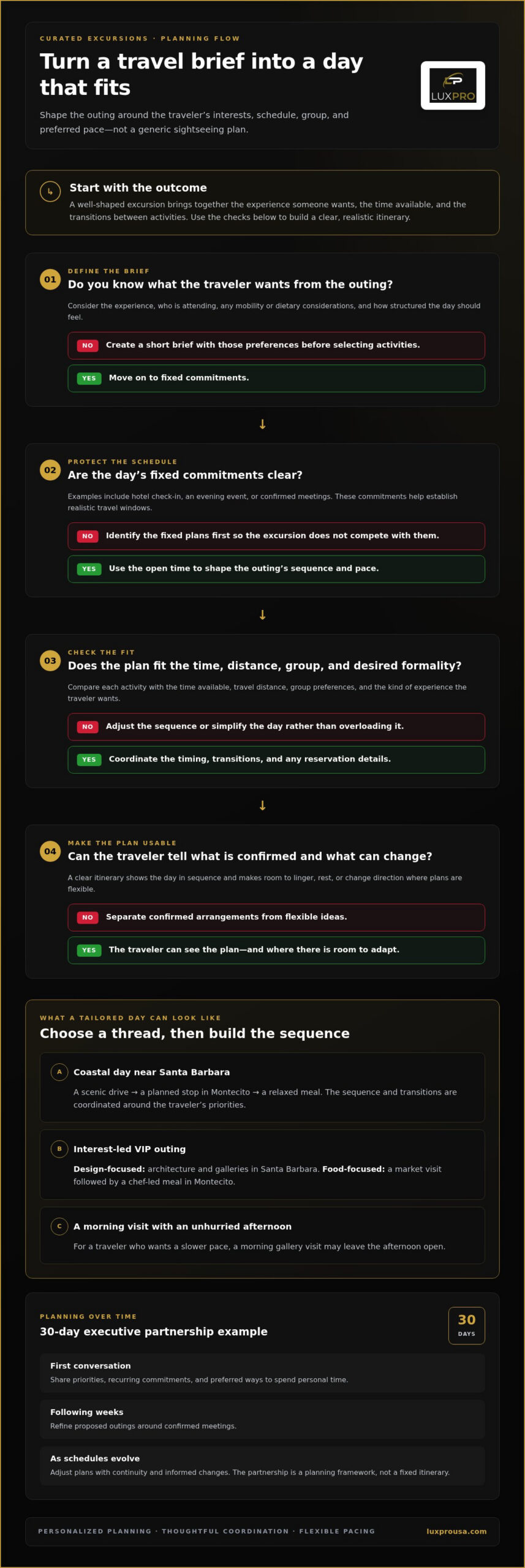
Curated excursions differ from generic sightseeing because the itinerary reflects the traveler’s interests, schedule, and preferred pace. A coastal day near Santa Barbara might combine a scenic drive, a planned stop in Montecito, and a relaxed meal. The concierge coordinates the sequence, timing, and transitions so each activity fits the client’s priorities rather than simply filling the day.
Start planning with a short brief: describe the experience you want, who is attending, any mobility or dietary considerations, and how structured the day should feel. Then note fixed commitments, such as hotel check-in or an evening event in Westlake Village. These details help establish realistic travel windows and prevent an excursion from competing with other plans. A morning gallery visit, for instance, may suit a traveler who wants an unhurried afternoon.
More than three-quarters of consumers believe a one-stop shop makes buying or selling more efficient and manageable. Coordinated travel arrangements can also make decisions easier to organize, though each excursion still depends on the traveler’s preferences and schedule. A concise itinerary can show the sequence of experiences, transportation transitions, and reservation details in one place. The traveler can then see how each activity fits the day.
A 30-day executive partnership experience illustrates how planning can develop over time. In the first conversation, the executive shares priorities, recurring commitments, and preferred ways to spend personal time. During the following weeks, a concierge can refine proposed outings around confirmed meetings, then adjust plans as schedules evolve. For example, an executive working in Beverly Hills might reserve a free afternoon for a coastal visit near Malibu and dinner nearby. The partnership model is a planning framework, not a fixed itinerary; its value comes from continuity and informed adjustments.
Tailor-made VIP experiences can focus on access, setting, or a particular interest rather than following a standard tour format. A design-focused traveler might prioritize architecture and galleries in Santa Barbara; a food enthusiast might prefer a market visit followed by a chef-led meal in Montecito. Compare each activity with the time available, travel distance, group preferences, and desired formality. Clear priorities help shape a distinctive outing without overloading the day.
The final itinerary should distinguish confirmed arrangements from flexible ideas and lay out the day in a clear sequence. Travelers can then see what is planned and where there is room to linger, rest, or change direction.
White-glove personal lifestyle management
White-glove lifestyle management coordinates personal and professional details around a client’s priorities. An elite concierge can bring household requests, travel arrangements, appointments, and administrative tasks together through one point of coordination. For example, a client preparing for a trip from Thousand Oaks can align a home appointment with departure plans and a family commitment in Westlake Village. The value comes from understanding how each request affects the wider schedule.
An elite concierge differs from a standard concierge or personal assistant in the breadth and continuity of coordination. A hotel concierge typically focuses on guest requests during a stay, while a personal assistant often handles defined tasks for one employer. Lifestyle management can connect different parts of a client’s life, including household arrangements, travel, and executive priorities.
Executive calendar and inbox management starts with identifying priorities, decision-makers, and deadlines. A practical process includes reviewing the calendar, grouping related commitments, flagging conflicts, and sorting messages by urgency. For example, an executive preparing for a board meeting in Beverly Hills could reserve focused preparation time, move a routine appointment, and surface messages requiring a decision. The client sets preferences for what can be scheduled, deferred, or escalated.
Clear boundaries make this support useful. The client can specify which meetings need personal approval, which invitations may be declined, and what counts as urgent. A concise daily summary can highlight schedule changes, pending decisions, and deadlines, helping the executive act promptly without treating every message as equally important. Calendar access and inbox handling should follow agreed privacy and communication practices.
Moving involves coordinating several connected tasks. A move manager can start with the destination, target date, household inventory, and essential services. The client can then organize packing, address updates, travel plans, and arrival arrangements in a shared sequence. For example, a family relocating from Thousand Oaks to Santa Barbara may need to align school records, household delivery, and initial appointments. A written task list clarifies responsibilities, dependencies, and next steps.
For a complex relocation, the client should identify fixed deadlines first, such as lease dates or a new role’s start date. Next, group tasks by location and urgency, then assign a responsible person to each item. Relocation support can help coordinate moving-related logistics as part of a broader lifestyle plan. This structure makes progress visible and reduces duplicated effort.
To shape support around executive routines, household responsibilities, or a move, share your lifestyle management priorities.
Concierge support during a stay
During a stay, an elite concierge can coordinate practical requests, travel details, and personal arrangements through a dedicated point of contact. People asking what an elite concierge service is often want to know how support works after arrival. It can include itinerary adjustments, local recommendations, and help resolving disruptions. For example, a delayed arrival in Thousand Oaks may require shifting a dinner reservation and revising the evening’s transportation plan.
How much does an elite concierge service cost in the United States? Pricing depends on the service scope, trip duration, request complexity, and booking requirements. The cost is provided after a quote request.
What membership fees and service charges do luxury concierge companies charge? Fees vary according to access, included coordination, and the nature of each request. The cost depends on the arrangement and services requested, rather than a single universal rate.
What is the process for requesting and booking concierge services? Share your stay dates, location, priorities, and fixed reservations. The concierge can organize the request, clarify details, and coordinate bookings or arrangements. Before confirming, review the itinerary’s timing, addresses, and relevant preferences.
Which elite concierge services are available in major U.S. cities? In Thousand Oaks, Calabasas, Malibu, and Westlake Village, requests may include restaurant planning, transportation coordination, local experiences, and practical stay support. Travelers in Santa Barbara or Montecito may want different outings from visitors staying in Beverly Hills or Oxnard. The right combination depends on the traveler’s plans and local itinerary.
Support can continue as plans change. Elite concierge services offer time savings through expert planning and peace of mind through 24/7 travel support. If weather disrupts an outdoor outing near Malibu, the concierge can help reorganize the day around indoor options and existing commitments. If a meeting in Woodland Hills runs late, the traveler can request adjustments to later arrangements. Clear priorities and timely updates help keep changes coordinated.
Before traveling, prepare a concise stay brief with arrival details, preferences, key appointments, and essential contacts. During the stay, share changes promptly and identify commitments that cannot move. A traveler with a morning appointment in Calabasas and an evening performance in Thousand Oaks, for example, can ask the concierge to account for both when adjusting the day. This context helps preserve the itinerary’s rhythm.
Discretion and confidentiality
Discretion starts with sharing only the personal details a request requires. For a restaurant booking, the concierge may need the guest count, preferred time, and dietary requirements, not a full travel history. Put preferences in a concise brief and separate essential details from optional context. This keeps planning focused and avoids unnecessary information exchange.
Set communication preferences before service begins. Specify whether updates should arrive by phone, email, or another agreed channel, and identify who may receive them. For example, a traveler might authorize an assistant to receive itinerary changes while keeping personal decisions to themselves. Clear boundaries help prevent sensitive plans from reaching the wrong person or appearing in an unsuitable setting.
Information handling should follow a clear routine. Agree on what details are recorded, who needs access, and how long records are needed to support the arrangements. A household calendar, for instance, may include an arrival time and appointment address while leaving out unrelated personal notes. Keep records relevant to the task, and avoid copying private details into messages that do not need them.
Discretion matters in person, too. When coordinating a private dinner, a concierge can use the agreed guest name, avoid discussing the occasion in public, and share arrival instructions only with relevant participants. For a family gathering, the host might ask that schedule details go directly to one designated contact. These small decisions help keep the experience composed and private.
For household and property requests, separate logistical coordination from sensitive personal information. A service note about a scheduled delivery may require an address and access instructions; it does not need details about the client’s wider routine. Estate management support relates to coordinating property needs, while the client can define which household details are appropriate to share for each task.
For security-related requests, keep the information specific and controlled. A client might describe the property concern, relevant timing, and preferred point of contact without circulating a full household schedule. A defined communication path keeps the discussion purposeful and separates the logistical request from unrelated personal details.
A simple privacy protocol makes expectations easier to follow. Set the approved contact method, name authorized recipients, identify sensitive details, and agree on how changes will be communicated. Before sharing a request, consider whether each detail is necessary. If a travel change affects only one reservation, send the update to the people handling it rather than forwarding the entire itinerary.
Confidential service depends on consistent judgment, not elaborate language. Practical instructions, such as using initials for a private event or directing schedule changes through one contact, give the concierge clear guidance. This helps keep assistance attentive, tailored, and unobtrusive.
Event tickets and restaurant reservations
Event and dining plans work best when they reflect the traveler’s schedule, preferences, and priorities. A concierge can coordinate a concert, gallery visit, or restaurant booking with the rest of an evening. For example, a guest attending a performance in Beverly Hills or Los Angeles may prefer dinner nearby, with enough time between the reservation and curtain. Sharing those priorities early gives the itinerary a clear structure.
For tickets, start with the event name, preferred date, party size, seating preferences, and any accessibility needs. Include a backup date or alternate performance if flexibility matters. A traveler seeking a particular artist can describe preferred sightlines or proximity to an exit. These details help identify suitable options. Before finalizing, review the event, date, seating, and ticket terms.
Restaurant requests benefit from the same precision. Share the preferred neighborhood, dining style, party size, dietary needs, and desired pace. A client planning a formal dinner in Malibu or Santa Barbara might request a quiet table near the coast, while a family may prioritize a welcoming menu and an earlier dining time. Clear preferences let the concierge focus on a suitable reservation rather than a generic recommendation.
Coordination matters as much as the individual booking. Compare the restaurant’s location with the venue, appointment schedule, and transportation plan. For a theater evening, choose a restaurant close enough in Thousand Oaks, Calabasas, or Westlake Village to make the transition manageable, then allow time for arrival and seating. If the event begins early, a later reservation may create unnecessary pressure. A coherent plan accounts for the sequence, not just each booking in isolation.
Before confirming arrangements, review the essentials in one itinerary: venue or restaurant name, date, arrival time, party size, and relevant booking instructions. Check that names and preferences match the request. For example, a reservation for a client with a dietary restriction should clearly reflect that need. Keeping event and dining details together makes it easier to share the right information with attendees.
Plans can change, so identify priorities and alternatives at the outset. If a performance time shifts, the concierge can reassess dinner timing and related arrangements. If a restaurant no longer suits the evening, a preferred cuisine and neighborhood provide useful direction for finding an alternative. Communicate changes promptly and distinguish essential requirements from preferences so the revised plan preserves what matters most.
A concise request can include the occasion, fixed commitments, preferred atmosphere, and practical constraints. For a birthday dinner followed by a live performance, note the guest count, dining preferences, venue, and desired pace. These details help coordinate the reservation and tickets into one considered evening.
LuxPro® USA: LuxPro® Airport Transportation
LuxPro® USA provides LuxPro® Airport Transportation for travelers arranging a polished arrival or departure as part of a luxury stay. It is a natural fit when you want airport transfers coordinated alongside your itinerary. For leisure plans, LuxPro® Wine Tour, LuxPro® Party Bus, and LuxPro® Yacht Charters offer additional ways to arrange distinctive transportation and experiences.
Choose the arrangements that fit your travel plans, whether you need airport transportation alone or a combination of relevant services. Contact LuxPro® USA to discuss your travel plans and arrange the right next step.
Shape Your Stay Around What Matters
Understanding what elite concierge service entails can help you decide which details deserve expert coordination and which you prefer to manage personally. Start with one priority for your next stay, such as a smooth arrival, a distinctive outing, or an occasion that calls for thoughtful planning. That gives your arrangements a clear starting point.
LuxPro® USA provides LuxPro® Airport Transportation, LuxPro® Wine Tour, and LuxPro® Party Bus. These services can complement different travel plans, from arrival logistics to a special group experience. Consider the role each arrangement should play in your itinerary, then contact LuxPro® USA to plan the details.
A well-considered plan starts with your priorities. Let the details come together around the stay you want to create.
Frequently Asked Questions
What Makes a Luxury Travel Concierge Service Worth the Investment?
Expert coordination can be worthwhile when it gives meaningful time back and supports a more considered trip. Its value depends on the requests involved, the traveler’s schedule, and how much coordination they want to manage personally. For a business traveler with a tight itinerary, organized arrangements can reduce the effort of handling separate details. Identify the most important tasks, then weigh the practical benefit against the service scope and terms.
How far in advance do I need to secure concierge services?
Start planning once your key travel dates and priorities are clear. Lead time depends on the request: a simple itinerary adjustment differs from coordinating several arrangements around a major event or holiday. For example, share the event date, guest count, and preferred dining style early, then identify which details are fixed. Early planning gives more room to coordinate the moving parts, while a focused request can still clarify immediate priorities.
What is an elite concierge service?
An elite concierge service provides tailored coordination for travel, lifestyle, and personal requests, shaped around a client’s preferences. Understanding what an elite concierge service is means looking beyond a single booking: the concierge helps organize connected needs and communicates according to agreed priorities. For example, a traveler attending a conference may need a schedule that balances professional commitments with personal plans, rather than a list of unrelated recommendations.
What services do elite concierge companies provide?
Services can include travel coordination, lifestyle support, private experiences, and help with personal or household arrangements. LuxPro® USA offers LuxPro® Airport Transportation, LuxPro® Wine Tour, LuxPro® Party Bus, LuxPro® Yacht Charters, LuxPro® Personal Shopper, and LuxPro® Estate Management. Its local focus includes Thousand Oaks, Calabasas, Malibu, Westlake Village, Santa Barbara, Montecito, Woodland Hills, Beverly Hills, Brentwood, Bel Air, Moorpark, Newberry Park, Oak Park, Oxnard, and Ventura.
How do you choose and vet an elite concierge service?
Start by defining the requests you need handled, your preferred communication style, and the level of privacy you expect. Then compare your needs with the service’s offerings. Someone arranging executive travel, for instance, may prioritize itinerary coordination, while a household manager may need property-related support. Review how requests are documented, who receives updates, and how changes are communicated. Clear expectations make it easier to judge whether the arrangement suits your priorities.
What are the benefits and limitations of elite concierge services?
Benefits can include coordinated planning, less administrative work, and recommendations tailored to a client’s preferences. The service is most useful when it addresses a defined need, such as coordinating personal arrangements around a demanding work schedule. Its scope depends on the service and the request. A concierge can organize and facilitate arrangements, but the client still makes personal decisions and should review important bookings and details.
What privacy, security, and liability risks should clients consider?
Consider what personal information a request requires, who will receive it, and how updates are shared. A household arrangement, for example, may need an address and access instructions, while unrelated schedule details may not be necessary. Clarify communication boundaries and authorized contacts before sharing sensitive information. For security-related arrangements, define the specific concern and intended coordination. Review booking terms and responsibilities so you understand who handles each part of the arrangement.
Disclaimer
https://luxprousa.com/privacy-policy/