

Are all chauffeurs discreet and under an NDA? A production should not assume every chauffeur is covered by an NDA. Set confidentiality expectations for the assignment in advance. Car service for film production in Woodland Hills also calls for discreet travel, dependable timing, and clear coordination for talent and crew.
Production schedules can shift, so transportation planning should account for call times, location changes, and late wraps. This guide covers chauffeur arrangements for talent and executives, crew travel between base camp, sets, and hotels, and planning transportation over a multi-week production. It also explains which schedule and vehicle details matter when organizing service in Woodland Hills, so you can plan around privacy and logistics.
Key Takeaways
- Set clear confidentiality expectations for each production assignment instead of assuming every chauffeur is covered by an NDA.
- Learn how production transportation plans can adapt to shifting call times, location changes, and late wraps.
- See which details help shape transportation planning for a multi-week production, including crew needs and route patterns.
- Understand how talent, executives, and crew may need different vehicle and chauffeur arrangements.
- Discover how schedules, trip requirements, and vehicle needs influence booking availability in Woodland Hills.
Film, television, and commercial production transportation
Production transportation connects talent, executives, and crews with studios, sets, hotels, and airports. In Woodland Hills, start planning with the itinerary, passenger roles, and the likelihood of schedule changes.
Film and Television Shoot Transport
Film, television, streaming, and commercial shoots may need separate travel plans for talent and production teams. Start by grouping trips by purpose, such as individual pickups, executive arrivals, or crew movements. This helps match each trip to its passengers and timing without assuming one arrangement will work for every department.
Discreet transportation also means limiting unnecessary exposure of passenger and itinerary details. Before service begins, set expectations for communications, pickup instructions, and who receives schedule updates. If confidentiality is essential, discuss written terms directly instead of assuming every chauffeur is under an NDA.
For a Woodland Hills production, the working plan should list pickup points, destinations, passenger counts, and the person coordinating changes. A film production transportation provider near Woodland Hills, CA, is a good fit when its service covers the actual itinerary, including Warner Center if it is part of the day.
Studio and Location Transfers
Transfers between a studio and filming locations depend on the route, arrival windows, and access instructions. Give the transportation team the studio name, location address, scheduled pickup time, and onsite contact. These details clarify where vehicles should arrive and whom the chauffeur should contact.
Film permits and parking arrangements depend on the location and planned activity. The production’s location coordinator can identify the applicable permissions and parking plan before vehicles arrive. Requirements can differ between a studio lot, public street, and private property, so there is no single rule for every filming setup.
For hourly transportation, list the service window and expected stops in the itinerary. If a shoot moves from a Woodland Hills base to a studio and then another location, the coordinator can send revised times and destinations through the agreed communication channel. A defined update process keeps the transportation plan clear when schedules change.
Vehicle rentals and chauffeured production transportation meet different needs. With a rental, the renter drives; a chauffeured arrangement includes a professional driver for planned travel between stops. Choose based on whether your production needs a driver as part of its transportation plan.
For productions spanning Woodland Hills and Warner Center, build the route around the specific studio and set addresses, rather than relying on neighborhood names alone. The transportation plan can include both areas when they’re part of the itinerary. Entertainment production transportation planning can account for studio, location, and production travel needs.
Can you provide crew shuttles for multi-week productions?
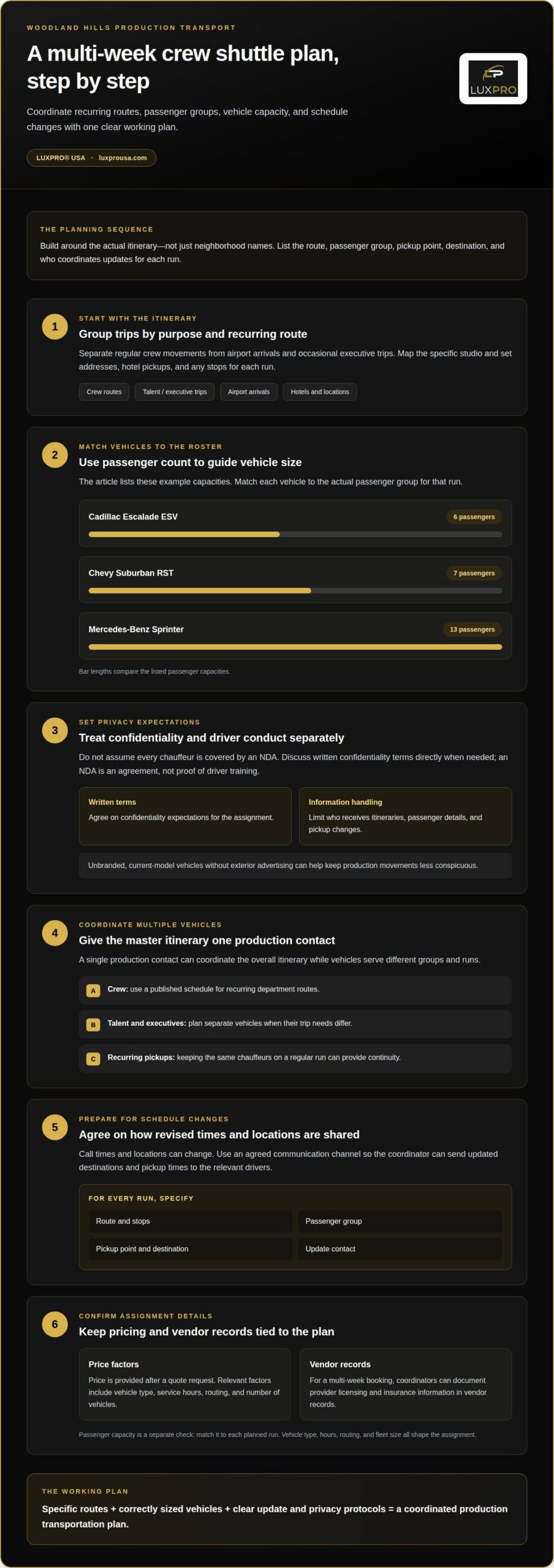
Multi-week productions can organize crew transportation around recurring routes, department needs, and changing schedules. Unlike a standard point-to-point car trip, production transportation coordinates vehicles and passenger groups across the production itinerary.
Discreet Vehicles and NDA-Trained Drivers
Unbranded, current-model vehicles without exterior advertising can help keep production movements less conspicuous. An NDA is a confidentiality agreement, not proof of driver training. Treat written confidentiality terms and professional conduct as separate parts of a privacy plan.
For a multi-week booking, decide who receives itineraries, pickup changes, and passenger details. Clear communication protocols limit unnecessary disclosure and give each driver a consistent process for handling schedule information throughout the assignment.
Vehicle Prices and Passenger Capacity
Vehicle selection should follow the passenger count for each run. Listed examples include a Cadillac Escalade ESV for 6 passengers, a Chevy Suburban RST for 7 passengers, and a Mercedes-Benz Sprinter for 13 passengers. These capacities help planners match vehicle size to a department’s actual roster.
Price depends on the assignment and is provided after a quote request; relevant factors include vehicle type, service hours, routing, and the number of vehicles. A multi-week plan should distinguish recurring daily transportation from airport arrivals or occasional executive trips, since each creates different scheduling needs.
Crew and Multi-Vehicle Coordination
Several vehicles work best with one production contact coordinating the master itinerary. A crew run might follow a published schedule while separate vehicles handle talent or executives. Assigning vehicles by department or hotel gives passengers a clear pickup plan and helps coordinators track route changes.
When a production changes locations, the coordinator can share revised times and destinations through the agreed communication channel. Keeping the same chauffeurs on a recurring run can provide continuity for regular pickups. For each run, specify the route, passenger group, pickup point, destination, and update contact.
Dedicated Drivers and Luxury Vehicles
A dedicated driver can suit a recurring itinerary when the same passenger or department needs regular transportation. Luxury sedans and SUVs may suit individual talent or executive travel, while a larger vehicle can carry a crew group. Choose based on passenger numbers, luggage, route frequency, and schedule.
Before a multi-week booking, production coordinators can document the provider’s licensing and insurance information in their vendor records. This is distinct from checking passenger capacity, which should match each planned run. For a tailored transportation plan, discuss your production requirements and outline the locations, schedule, and passenger groups.
Booking lead times and availability
Production bookings depend on the schedule, vehicle type, route, and number of vehicles requested. For a television shoot in Woodland Hills, booking early gives the coordinator more time to align transportation with call times, location changes, and crew requirements. The planning window depends on the itinerary and vehicle demand.
Share the working schedule as soon as production dates and locations take shape. Mark confirmed pickups separately from pending details, such as a final wrap time or an additional filming location. This helps the transportation team plan around known commitments while keeping revisions organized.
Useful booking details include:
- Production dates, service hours, and anticipated schedule changes.
- Pickup and destination addresses, including studios and filming locations.
- Passenger groups, vehicle preferences, and any Sprinter or limousine requirements.
- The production contact responsible for itinerary updates and booking decisions.
A production with daily crew movements and occasional executive trips has different vehicle needs from a single-location shoot. Separate recurring transportation from one-time trips to make the request clearer and account for vehicle size, driver assignments, waiting periods, and travel between locations.
The requested dates, vehicle category, service hours, and need for multiple vehicles all shape the plan. A schedule that includes studio work and off-site events may call for a different arrangement from a continuous set-to-hotel route. Updating the itinerary as details develop gives the booking plan a more accurate operational basis.
For airport arrivals, include the airport, arrival details, passenger, and destination in the travel plan. Keeping these details with the production itinerary distinguishes airport pickups from local set transportation. LuxPro® Airport Transportation can be planned alongside the broader schedule for incoming cast or executives.
Professional booking also involves production-side payment coordination. The production should identify the authorized booking contact and billing contact, then align those roles before service begins. Pricing depends on the assignment and is provided after a quote request; relevant factors include vehicle type, hours, routes, and the number of vehicles. A concise request with the schedule and trip requirements supports a clear quote.
As dates shift, send revisions through the designated production contact and include the affected pickup, destination, and timing. Moving a call location may change driver timing or vehicle assignment as well as the address. A documented update process keeps the transportation plan aligned with the latest itinerary.
Chauffeur service for talent, executives, and production crews
Production transportation works best when passenger roles and trip purposes guide vehicle assignments. Separate arrangements can serve talent, executives, and crew while keeping pickups aligned with the production schedule.
Talent, Executive, and VIP Movements
Black SUVs and sedans with assigned chauffeurs suit individual talent and executive movements. Executive Mercedes Sprinters and mini coaches can serve crew groups, keeping individual arrivals distinct from group travel. For each assignment, provide the passenger group, pickup location, destination, and timing. These details help coordinate movements without treating every passenger as part of one itinerary.
High-profile talent may need additional privacy or security planning. LuxPro® Executive Security provides security services for high-profile talent. This is separate from chauffeur assignment: transportation covers the journey, while security supports the talent’s broader movement plan.
Talent Pickup and Drop-Off
A clear pickup plan identifies the arriving passenger, meeting point, destination, and production contact. For airport arrivals, real-time flight monitoring helps coordinate vehicle readiness with incoming talent’s arrival. LAX and Hollywood Burbank Airport are examples of commercial airports used for production travel; Van Nuys has private aviation facilities.
At a studio or filming location, specify the designated entrance or pickup point and onsite contact. A talent pickup from a hotel, for example, should include the hotel address and set destination. A later drop-off may require a separate destination and time, rather than assuming the return follows the same route.
Executives often have an itinerary that differs from the cast’s. Their day might include an airport arrival, a studio meeting, and a later transfer to another location. Keep those stops together in one passenger itinerary to make chauffeur assignment and updates easier. A crew group, by contrast, may travel in a Sprinter or mini coach on a separate run.
For commercial airport arrivals, distinguish LAX, Burbank, John Wayne, Long Beach, and Ontario by airport and passenger. Private aviation movements may use FBOs at Van Nuys, Hawthorne, or Burbank. Naming the arrival point and destination helps organize each transfer without confusing airport pickups with studio calls.
Production contacts can organize the movement plan by passenger group:
- Talent and executives assigned to black SUVs or sedans.
- Crew groups assigned to executive Sprinters or minibuses.
- High-profile talent movements that include licensed private security.
- Airport arrivals documented with passenger, arrival point, and destination.
For a Woodland Hills shoot, give each chauffeur an assigned passenger or group, pickup point, destination, and production contact. This structure supports discreet arrivals and coordinated drop-offs, whether the day includes a studio call, an airport transfer, or travel between filming locations.
Crew shuttles between base camp, sets, and hotels
A crew shuttle plan connects base camp, filming locations, and hotels through a shared schedule. For an entertainment production in Woodland Hills, design routes around department call times, pickup points, and the day’s location sequence.
A published schedule gives crew members a consistent reference for departures and stops. Production transportation can assign vehicles by department or hotel, then retain the same chauffeurs on recurring runs. For example, one route might serve a hotel group while another links base camp with a set. Dispatch can use the production contact to communicate timing or route changes.
Distinguish fixed movements from flexible ones in the schedule. Mark confirmed pickup times and planned stops, and flag any special movement that needs separate handling. If filming moves from a Woodland Hills location to a studio, identify the new destination and affected passenger groups. This keeps the shared schedule useful without treating every crew member as part of one route.
Cast and crew often have different transportation patterns. Crew members may travel together between a hotel and base camp, while cast pickups follow individual call times. Organize separate runs for each group, with the pickup location, destination, and responsible contact listed for every schedule. This reduces confusion at busy call times without combining unrelated trips.
Cast and crew trailers can also affect pickup planning when they serve as work or staging locations. A shuttle itinerary can identify the trailer area as a meeting point, then connect it with base camp or the filming location. A crew member leaving a production trailer for a set needs a specific pickup point, not a general reference to the lot. The location contact can share access instructions with dispatch.
For multi-week work, recurring routes benefit from a stable schedule and a clear revision process. The production coordinator can circulate the current timetable, identify the version in use, and send changes to the transportation contact. If a wrap time shifts, specify which route and passenger group are affected. Keeping the same chauffeurs on a recurring run can build familiarity with regular stops.
A major production may also need private movements alongside shared crew runs. Keep these itineraries separate, particularly when talent, executives, or special guests have different pickup instructions. State whether each movement is a group shuttle or individual trip, and list its destination and contact. This helps dispatch coordinate the appropriate vehicle and schedule.
For a Woodland Hills production, start with a route list covering hotels, base camp, trailers, and sets. Pair each stop with its department or passenger group, then establish how dispatch receives approved schedule updates. This gives production staff a clear framework for recurring crew travel without confusing it with individual transportation.
LuxPro® USA: LuxPro® High Priority Courier Service
LuxPro® USA offers LuxPro® High Priority Courier Service for production teams moving time-sensitive materials or documents. This serves a different need from passenger transportation: a production coordinator can arrange a courier when an item needs its own delivery plan rather than a place in a crew vehicle.
For example, a team handling a schedule change may need production paperwork or materials delivered to a specified destination. The courier service can complement a transportation plan without replacing crew shuttles, talent pickups, or airport transfers. Share the delivery requirements and destination when arranging the service.
For production delivery arrangements, contact LuxPro® USA.
Set Your Production Transportation Plan in Motion
Make transportation part of pre-production planning, not a last-minute adjustment. A concise movement brief gives department leads a shared reference for approvals, passenger priorities, and schedule updates. For car service for film production in Woodland Hills, this planning also creates a clear starting point for discussing your requirements.
LuxPro® USA offers LuxPro® Airport Transportation for travel beyond the set. For separate occasions, LuxPro® Wine Tour and LuxPro® Party Bus provide additional transportation options. Choose the service that fits each occasion to keep the production plan purposeful and tailored.
Discuss your transportation needs directly with LuxPro® USA to plan the next step.
A considered transportation plan gives your team a confident foundation for the work ahead.
Frequently Asked Questions
Are all chauffeurs discreet and under NDA?
Professional discretion is expected, but it shouldn’t be treated as proof that every chauffeur has signed an NDA. LuxPro® USA uses vetted drivers who complete a 30-day training period before they’re allowed to operate. For a production requiring written confidentiality terms, establish those terms as part of the booking. A clear protocol can also specify who may receive passenger names, pickup details, and schedule updates.
How do you handle early call times?
LuxPro® USA provides service 24 / 7, 365 days a year, which includes early call times. The production coordinator can provide the pickup address, passenger details, destination, and required arrival time when arranging transportation. For airport rides, the service includes a 60-minute complimentary wait time. A confirmed itinerary gives the chauffeur and production contact a shared reference for the scheduled pickup.
What is the cost of car service for film production in Woodland Hills?
LuxPro® USA uses flat-rate pricing with zero hidden fees. The quoted price includes the vehicle, chauffeur, fuel, flight-tracking, wait time, and gratuity. Share the itinerary and transportation requirements when requesting a quote so the service can be priced for the assignment. The cost is not stated as a general production-wide figure, since each booking requires its own quote and confirmed travel details.
What are the hourly and daily rates for production drivers and SUVs in Woodland Hills?
LuxPro® USA provides flat-rate pricing rather than publishing hourly or daily rates for production drivers and SUVs. The quoted price includes the vehicle, chauffeur, fuel, flight-tracking, wait time, and gratuity. For a production in Woodland Hills, submit the requested service dates, itinerary, and vehicle needs to receive pricing for the specific booking. This keeps the quote tied to the actual assignment rather than a generic rate.
How does a production car service provider arrange transportation for a film shoot in Woodland Hills?
A production transportation plan begins with the schedule, pickup and destination addresses, passenger groups, and vehicle needs. For a car service for film production in Woodland Hills, the production contact can organize those details into an itinerary, separating confirmed movements from later updates. LuxPro® USA can use that information to prepare a tailored transportation quote and coordinate relevant airport transfers through LuxPro® Airport Transportation.
What vehicles are available for cast and crew transportation?
Vehicle options include late-model sedans and SUVs, stretch limousines, Mercedes Limo Sprinters, executive jet vans, and mini coaches. A 56-passenger charter bus is also part of the fleet. An individual cast pickup may call for a sedan or SUV, while a larger crew group may require a Sprinter, mini coach, or charter bus. The production itinerary and passenger group help determine the suitable vehicle.
Disclaimer
https://luxprousa.com/privacy-policy/