

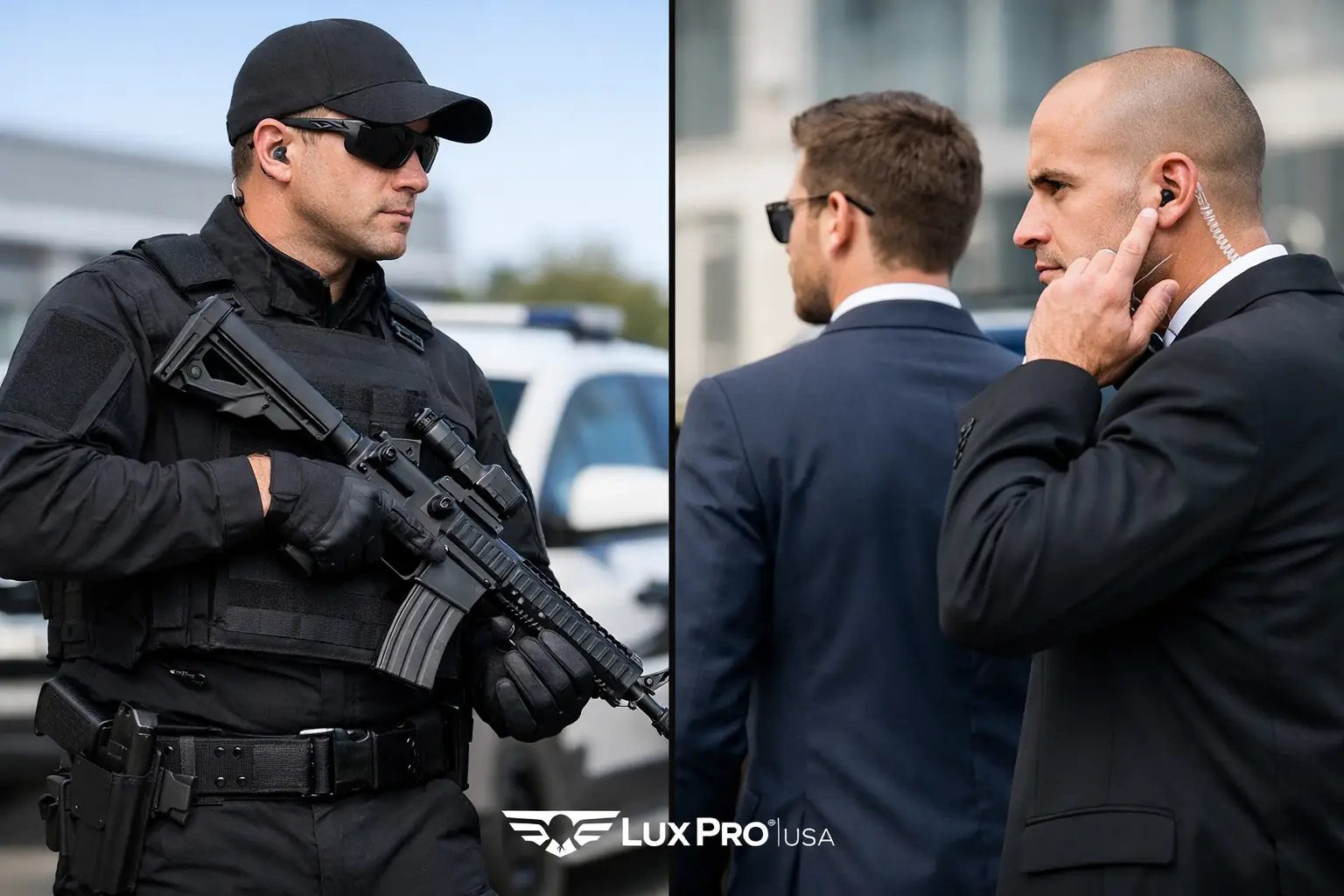
A high-profile arrival at LAX, a discreet evening in Malibu, or a family gathering at a private estate can require more than a driver and a reservation. The choice between armed security vs bodyguard service affects how protection is delivered, how visible it feels, and how well it supports the rest of the day. For executives, families, public figures, and estate owners, the right answer is rarely about appearances. It is about a measured response to real risk, personal preferences, and the need to move through life without unnecessary disruption.
Armed Security vs Bodyguard: The Core Difference
Armed security is defined primarily by capability and assignment. An armed security professional is licensed and authorized, where permitted by state and local law, to carry a firearm while protecting a person, property, asset, or location. Their work may involve access control, perimeter awareness, patrols, threat deterrence, secure transport support, or monitoring an estate and its entry points.
A bodyguard, more precisely described in the professional world as an executive protection agent, is defined primarily by mission. This professional protects a specific person or family, often remaining close enough to identify risks before they become immediate problems. The role can include advance planning, travel coordination, discreet venue arrivals, route awareness, crowd management, secure transitions, and close-protection coverage.
These categories overlap. A bodyguard may be armed if the assignment, jurisdiction, licensing, and risk assessment support it. An armed security officer may provide close protection for a principal. The distinction matters because carrying a firearm does not automatically make someone qualified for executive protection, and a skilled bodyguard does not need to be armed on every assignment.
The strongest security planning starts with the question: What needs protection, from what, and in what setting? That answer should shape the personnel, protocol, visibility, and equipment involved.
When Armed Security Is the Better Fit
Armed security is often appropriate when the priority is protecting a place, a valuable asset, or a defined operational environment. An estate with expansive grounds, multiple access points, household staff, deliveries, and recurring vendor traffic has different needs from an executive attending a private dinner. Visible security may also provide a meaningful deterrent at a large event, luxury retail activation, construction site, private collection, or high-priority courier transfer.
For an estate, armed coverage can be structured around entry and exit procedures, visitor verification, patrol patterns, incident response, and communication with household management. The professional presence is intentional. It signals that the property is monitored and that access is controlled.
For secure transportation, an armed security component may be considered when travel involves a known risk profile, high-value items, sensitive schedules, or public exposure. Yet the presence of armed personnel should never be treated as a default luxury add-on. It introduces legal, logistical, and social considerations. Proper licensing, training, insurance, use-of-force standards, and coordination with the transportation plan are essential.
Armed security can be highly discreet when needed, but it is generally more overt than a low-profile executive protection detail. If a client’s goal is a visible deterrent at an estate gate or event entrance, that visibility may be an advantage. If the objective is to preserve a relaxed, private experience for a family or guest, a different approach may be better.
When a Bodyguard or Executive Protection Agent Is the Better Fit
A bodyguard is usually the better choice when protection must travel with the client and adapt minute by minute. A principal may need coverage from a private residence to the airport, through a series of meetings, to an entertainment venue, and back to a hotel or home. The assignment requires more than standing post. It requires anticipation.
The best executive protection agents remain observant without becoming intrusive. They understand how to coordinate with chauffeurs, aviation teams, household staff, venue management, and assistants. They can help create calm transitions through crowded arrivals, protect privacy during public-facing engagements, and identify alternate options before a schedule change becomes a security issue.
For many clients, the service is as much about discretion as defense. A polished agent knows when to take the lead and when to step back. They may dress to blend with a corporate delegation, formal event, or casual family itinerary rather than draw attention to the fact that protection is present.
This is especially valuable for entertainment professionals, executives facing public scrutiny, high-net-worth families managing travel with children, and anyone whose exposure changes throughout the day. The goal is not to create a dramatic security scene. It is to make each movement feel organized, private, and controlled.
Close Protection Is Not Just Physical Presence
A professional bodyguard’s value begins before the client leaves the residence or steps off a private flight. Advance work may include reviewing the itinerary, assessing venue access, identifying safe pickup locations, confirming communication protocols, and planning alternate routes or exits. The agent considers practical details that are easy to overlook, such as where a chauffeur can stage, how guests will enter, or which arrival point provides the most privacy.
That planning reduces exposure and minimizes last-minute decisions. It also supports a better client experience. Security should not compete with hospitality. At its best, executive protection quietly strengthens it.
The Decision Should Be Based on Risk, Not Status
A visible armed detail can look impressive, but security should never be selected as a symbol of importance. Overprotecting a low-risk situation can make guests uncomfortable, disrupt an event, and create complications at venues or across jurisdictions. Underprotecting a situation with credible concerns can leave a client, family, staff, or property unnecessarily exposed.
A thoughtful assessment considers the client’s public profile, recent threats or unwanted contact, travel patterns, family circumstances, destination, property layout, event size, valuables, and desired level of privacy. It should also consider whether the concern is personal, operational, or site-based.
For example, an executive traveling between controlled corporate locations may benefit most from a discreet protection agent paired with a professional chauffeur. A family estate hosting a large celebration may need access control and perimeter coverage in addition to close protection for one or two principals. A public figure attending a high-traffic event may require an advance agent, secure transportation coordination, and a close-protection presence that can navigate crowds without escalating attention.
The scope can change as conditions change. A long-term estate program may be appropriate for one household, while another client may only need a protective detail for a sensitive trip, a court appearance, a high-profile event, or a period of increased exposure.
Licensing, Training, and Local Rules Matter
The word “armed” carries serious responsibility. Firearm authority, security licensing, concealed-carry rules, and executive protection requirements vary by state, city, venue, and assignment. A security team must operate within the laws of every location on the itinerary, particularly when travel crosses state lines or includes airports, private aviation terminals, entertainment venues, or international destinations.
Clients should expect a provider to address credentials, background screening, insurance, experience, communication procedures, and escalation standards. They should also expect clarity on what the team can and cannot do. Professional protection is grounded in prevention, judgment, and de-escalation. Force is a last resort, not the foundation of the service.
Training should extend beyond firearms where armed assignments are involved. Strong personnel are skilled in situational awareness, emergency response, secure driving coordination, communication, medical readiness, conflict management, and client confidentiality. The ability to remain composed under pressure is every bit as valuable as physical capability.
How Security and Luxury Service Work Together
For premium clients, logistics and protection are closely connected. A delayed vehicle, an exposed hotel arrival, a poorly managed guest list, or an unvetted vendor can become more than an inconvenience. It can create avoidable risk. That is why coordinated service matters.
A single trusted team can align executive protection with chauffeured transportation, aviation schedules, estate operations, event planning, and personal assistance. The result is not a more conspicuous experience. It is a more controlled one, with fewer handoffs and fewer unknowns. LuxPro® USA approaches protective planning with this white-glove mindset, pairing discretion and security awareness with the polished coordination clients expect.
The best arrangement also respects the client’s lifestyle. Some principals prefer a clearly identifiable agent at their side. Others want protective coverage that is nearly invisible to guests, colleagues, and family. Neither preference is inherently better. The right presentation depends on the environment, the risk assessment, and the client’s comfort.
Choosing the Right Level of Protection
Ask whether the central concern is a person, a property, or both. Then consider whether a visible deterrent would help or hinder the experience. If the assignment centers on an estate, event entry point, valuable asset, or defined site, armed security may be the appropriate foundation. If the assignment follows an individual through changing locations and public interactions, a bodyguard or executive protection agent is typically the more natural fit.
For higher-risk or more complex situations, the answer may be both: close protection for the principal, supported by armed personnel for the site or secure perimeter where legally appropriate. The plan should be tailored, not oversized or generic.
The most reassuring security detail is often the one that allows you to focus on business, family, travel, or celebration without thinking about security at all. Choose professionals who understand that protection is not merely about presence. It is about preserving privacy, comfort, and freedom of movement when those things matter most.