

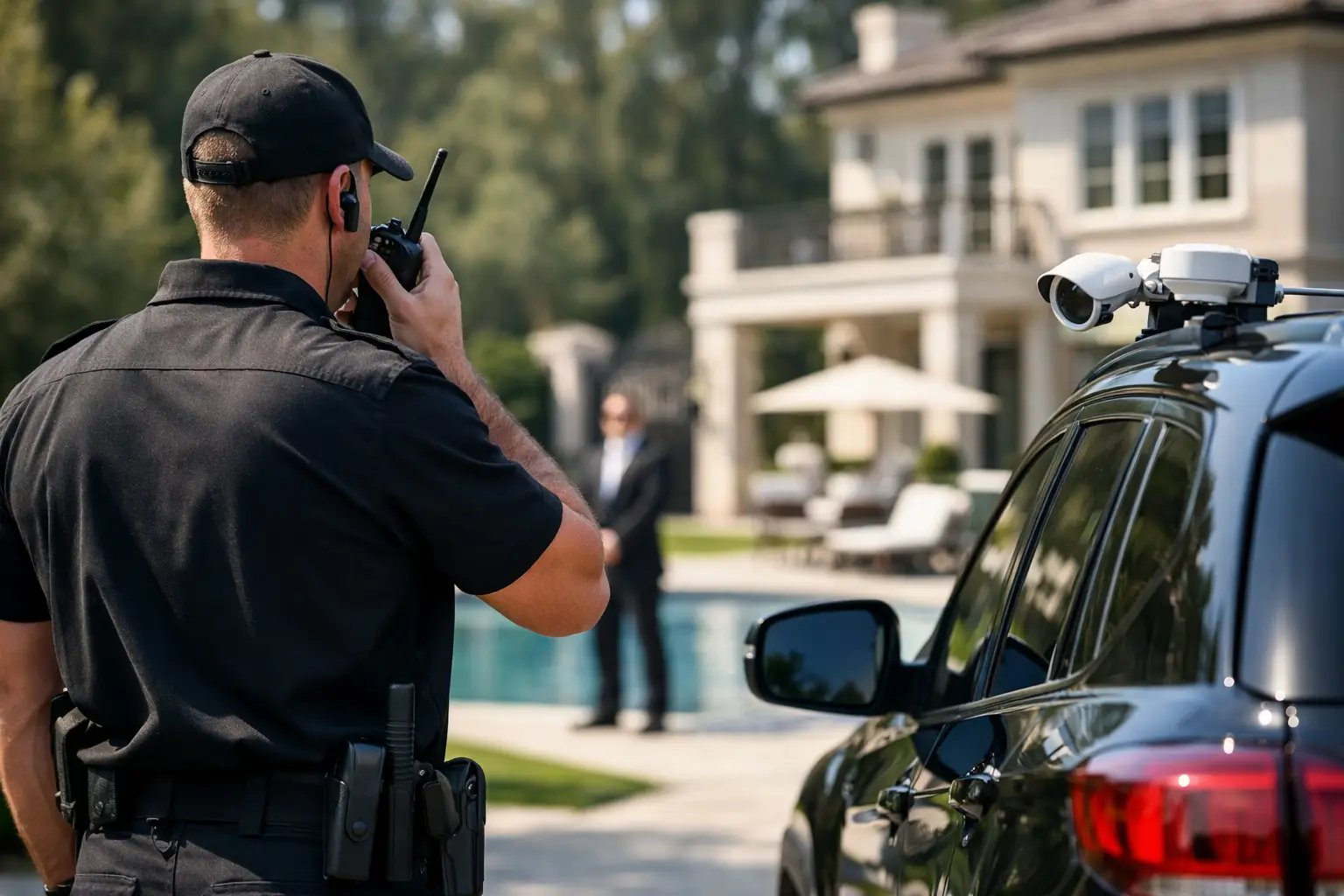
A front gate, a camera system, and a few alarms may look sufficient on paper. They rarely are. For high-value homes, visible assets, and families with demanding schedules, estate security services are not about adding more hardware. They are about creating a private, controlled environment where movement, access, staff activity, deliveries, and daily life are managed with precision and discretion.
That distinction matters most when a residence is more than a residence. A modern estate may function as a family home, executive retreat, event venue, temporary office, travel hub, and storage location for vehicles, art, jewelry, or sensitive records. Security in that setting cannot be treated as a single product. It has to operate as a coordinated service.
What estate security services actually cover
The phrase estate security services is often misunderstood. Some assume it means a guard at the gate. Others picture a high-visibility executive protection team. In practice, the right solution sits somewhere between hospitality and protection, with the balance determined by the household itself.
A well-run estate security program starts with the property layout, the family profile, and the household rhythm. Who lives there full time. How often guests arrive. Whether children, domestic staff, vendors, or visiting executives are moving in and out. Whether the principal is public facing. Whether there have been prior incidents involving trespassing, stalking, theft, or unwanted attention. These details shape the plan.
For one estate, the priority may be discreet perimeter monitoring and access control. For another, it may be resident safety during arrivals and departures, overnight coverage, staff supervision, and coordination with chauffeured transportation. The service is not one-size-fits-all, and that is exactly why experienced oversight matters.
Why affluent households need more than basic home security
Standard residential security systems are useful, but they are reactive by design. They alert after something has already triggered a sensor, opened a gate, or breached a perimeter. High-value households often need a model that reduces exposure before an event escalates.
That means thinking beyond break-ins. Privacy is often the real concern. A home can become vulnerable through social media visibility, domestic staffing gaps, service entrances, predictable routines, unmanaged guest lists, or vendors who know too much about who is home and when. Even innocent inefficiencies can create risk.
The strongest estate security presence is usually the one that blends into the property while keeping control firmly in place. Residents should feel at ease, not watched. Guests should feel welcomed, not interrogated. Staff should know procedures clearly, without the home taking on the atmosphere of a commercial site.
This is where white-glove standards make a difference. Security personnel on an estate are not just protecting assets. They are operating inside a private lifestyle environment. That requires professional judgment, polished communication, and a service mindset that respects the household’s tone.
The core elements of effective estate security services
Physical presence is only one layer. The most effective estate security services combine trained personnel, site procedures, communication protocols, and lifestyle coordination into a single operating plan.
Access control is central. Every estate has entry points that need to be managed differently, from gates and garages to staff entrances and delivery zones. A mature program defines who may enter, how they are verified, where they may go, and who is notified. That sounds simple until there are contractors on site, household staff changing shifts, floral deliveries arriving before an event, and family members coming and going without a fixed schedule.
Perimeter awareness matters just as much. Cameras and alarm systems support coverage, but they do not replace trained observation. A professional team can detect unusual vehicle patterns, loitering, unauthorized photography, repeated delivery attempts, or behavioral cues that technology alone may miss.
Resident movement is another critical factor. Estate security should extend to departures, arrivals, and transitions between home, airport, office, school, or private events. This is where coordination with transportation and concierge support becomes especially valuable. When security, mobility, and scheduling operate together, exposure points shrink.
Incident readiness also separates premium providers from basic coverage. A qualified team should know exactly how to respond to medical concerns, unauthorized access, suspicious persons, domestic disturbances, utility failures, or fire and life safety events. Calm execution matters. So does knowing when to remain discreet and when to escalate.
Estate security services and household staff coordination
Many estate vulnerabilities come from operational complexity rather than obvious threats. Multiple vendors, rotating domestic staff, visiting guests, seasonal events, and maintenance projects can quietly weaken control if nobody is managing the full picture.
Security personnel should not work in isolation from estate managers, assistants, chauffeurs, or principals. They need a shared understanding of household expectations, approved access, family routines, and communication channels. Without that alignment, even well-trained professionals can create friction or miss key information.
For example, a delivery that appears routine may be unauthorized. A guest who seems expected may have arrived at the wrong entrance. A contractor may need restricted movement because a family member is present. These moments are handled best when estate operations and security are synchronized rather than siloed.
That is one reason many clients prefer a single trusted provider with white-glove service standards across related offerings. Security becomes stronger when it is informed by transportation schedules, household logistics, travel changes, and event planning, rather than reacting to them after the fact.
Choosing estate security services that fit the property
The best solution depends on the estate, the principal, and the level of public exposure. A waterfront property with frequent entertaining needs a different posture than a gated family residence in a quiet neighborhood. A public figure may require a more active deterrence model. A private executive may prioritize low-profile coverage that is almost invisible to guests.
It also depends on the household’s preferences. Some clients want a uniformed presence at the entry and visible patrols. Others want plainclothes professionals who integrate into the environment with minimal visibility. Neither approach is inherently better. The right answer comes down to risk profile, property design, and personal comfort.
Experience should be evaluated carefully. Discretion is not a slogan in this category. It is a professional discipline. Estate personnel must understand confidentiality, resident etiquette, de-escalation, documentation, and the difference between being attentive and being intrusive. Screening and background standards are equally important, especially when professionals are working in close proximity to families, children, and private living spaces.
A premium provider should also be able to scale. Needs change. A quiet week at home may require different coverage than a holiday gathering, extended travel, a renovation project, or a high-profile visit. Security should adapt without forcing the household to start from scratch each time.
When integrated service becomes a real advantage
For many high-net-worth households, the challenge is not finding individual vendors. It is managing too many of them. One company handles vehicles, another handles staffing, another handles security, and another handles special requests. The result is often fragmented communication and avoidable exposure.
Integrated support creates a cleaner operating environment. If estate security is coordinated alongside chauffeured transportation, executive movement, concierge logistics, and household support, timing improves and handoffs become tighter. Drivers know when residents are cleared for departure. Security knows when guests are expected. Assistants are not left relaying updates across multiple teams.
This model is especially effective for principals who move between private residences, offices, airports, events, and leisure travel on compressed schedules. In those settings, security is strongest when it is not treated as a separate department but as part of a broader white-glove service framework. That is where a provider such as LuxPro® USA can offer a meaningful advantage, particularly for clients who value discretion, continuity, and one trusted point of coordination.
Estate security services are ultimately about confidence
The real value of estate security is not the visible deterrent, although that has its place. It is the confidence that the home is being monitored intelligently, that access is controlled professionally, and that daily life can continue without unnecessary disruption.
Done well, security supports the quality of living on the estate. It protects privacy without creating tension. It respects family routines while preparing for the unexpected. It gives principals, relatives, staff, and guests a sense that everything is handled.
That is the standard worth expecting. Not more noise, not more hardware, and not more complication. Just the right presence, the right planning, and the right people protecting what matters most.