

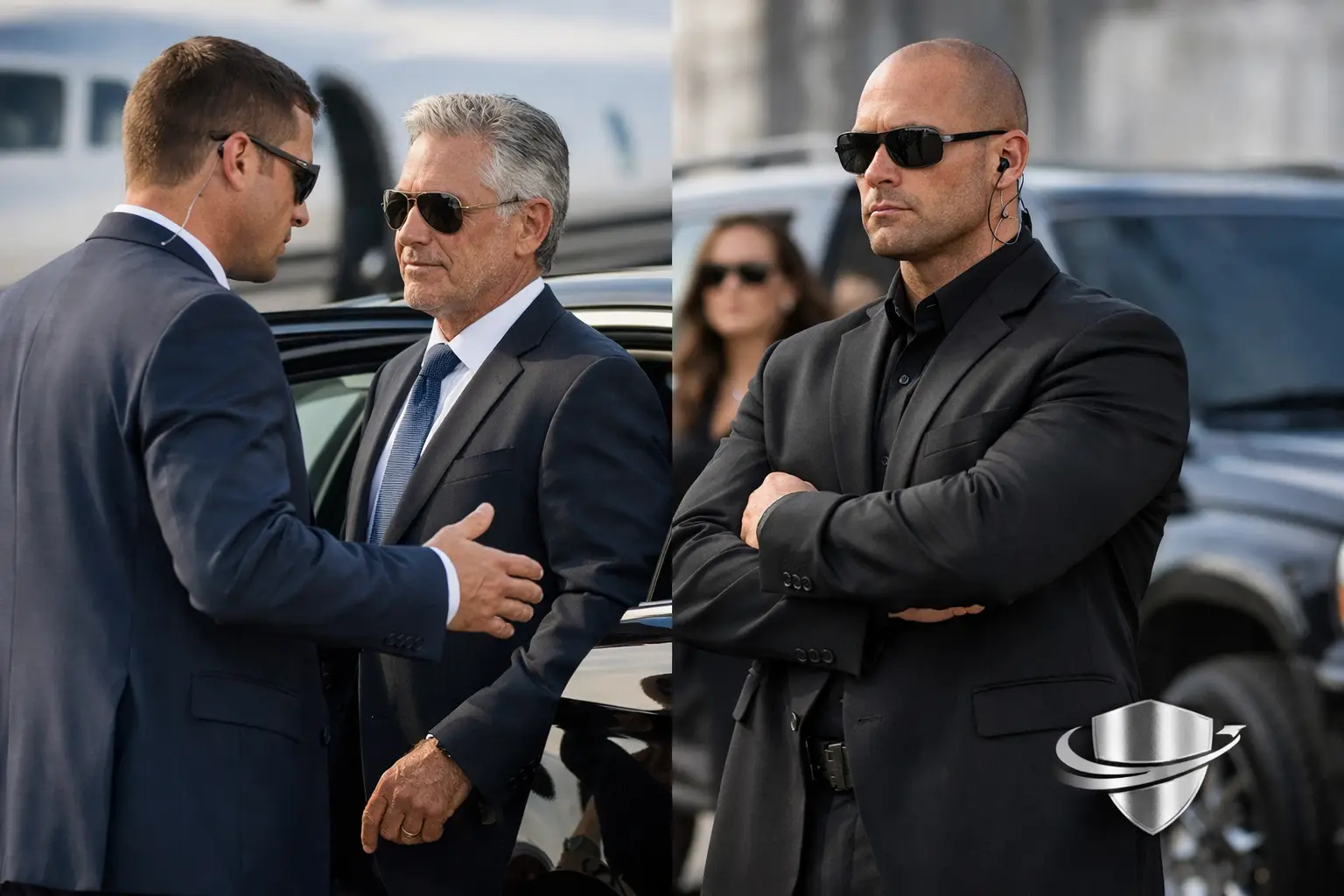
A principal leaving a private terminal, stepping into a vehicle, and arriving at a board meeting may appear to need a single visible security professional. In reality, the decision between executive protection vs bodyguard services determines whether security begins at the curb or well before the itinerary is finalized. For executives, public figures, high-net-worth families, and estate owners, that distinction can shape privacy, punctuality, and the ability to move through the day without unnecessary disruption.
A bodyguard can be an appropriate solution for a specific concern. Executive protection is designed for a broader responsibility: protecting the person, the schedule, the environment, and the information surrounding the principal. Neither option is automatically better. The right choice depends on the risk profile, visibility, travel pattern, family needs, and desired level of discretion.
Executive Protection vs Bodyguard: The Core Difference
The simplest distinction is reactive presence versus proactive protection. A bodyguard is commonly understood as a close-protection professional who stays near a client to deter, identify, and respond to immediate threats. The role can be highly capable and essential, particularly for an event appearance, a high-profile public engagement, or a known short-term concern.
Executive protection takes a wider view. An executive protection detail assesses risk in advance, plans movements, coordinates secure transportation, reviews venues and routes, monitors changing conditions, and establishes contingencies before the principal arrives. The protective agent remains close enough to act when needed, but the most successful work often goes unnoticed because problems are avoided rather than confronted.
This is not merely a difference in title. It is a difference in operating model. A professional executive protection program may include advance work, protective intelligence, itinerary management, communications protocols, driver coordination, medical readiness, and liaison with household staff, corporate teams, or event organizers. The goal is composed, uninterrupted movement with a low profile.
What a Bodyguard Typically Provides
The term bodyguard covers a broad range of professionals and capabilities. At its best, a bodyguard provides an alert, physically capable protective presence for a client facing an identifiable exposure. This may include crowd management, escorting the client between locations, observing people and surroundings, maintaining personal space, and responding decisively in an emergency.
A bodyguard may be the practical fit when protection is needed for a limited window. Consider a celebrity appearance, a contentious meeting, a late-night event, or a temporary concern involving unwanted attention. In these situations, a single experienced professional can provide reassurance and a clear layer of deterrence without building a full protective operation.
The trade-off is scope. One person cannot simultaneously conduct a route advance, secure a vehicle, observe a crowd, manage an entry point, coordinate a driver, and remain fully focused on the principal. That does not diminish the value of a bodyguard. It simply means the assignment must be matched to the actual exposure rather than the label used to describe it.
How Executive Protection Works Beyond the Principal
Executive protection is built around anticipation. Before a client departs, the team considers where the principal will be, who will have access, how visible the movement will be, what alternatives are available, and how a change in plans will be handled. A protected principal should not have to make security decisions while managing a company, family office, production schedule, or international itinerary.
Advance Planning and Protective Intelligence
Advance planning can be as straightforward as confirming secure entrances and parking for a private dinner. For a more complex trip, it may involve reviewing hotel layouts, coordinating airport arrivals, identifying medical resources, selecting preferred routes, and verifying who is authorized to access the client.
Protective intelligence adds context. The team evaluates whether a particular appearance, dispute, social media post, business transaction, or travel destination changes the client’s exposure. The purpose is not to create anxiety. It is to make measured decisions based on credible information rather than assumptions.
Secure Mobility and Driver Coordination
Luxury transportation and executive protection work best when they are coordinated. A highly trained chauffeur understands timing, discretion, passenger comfort, and vehicle readiness. A protective agent understands positioning, transitions, and how to preserve a safe path between locations. When those functions operate separately, even a simple arrival can become unnecessarily visible or disorganized.
For clients moving between Los Angeles meetings, Malibu residences, private aviation terminals, and event venues, the vehicle is often the most important part of the protective environment. It should be professionally maintained, correctly positioned, and managed by personnel who understand the schedule without broadcasting it.
Low-Profile Presence
Many clients do not want an obvious security formation. They want to dine, travel, attend meetings, and spend time with family without drawing attention to the fact that protection is present. Executive protection can be tailored accordingly, from discreet close protection to a more visible detail when deterrence is the priority.
The strongest professional does not confuse visibility with effectiveness. At times, a formal presence is appropriate. At other times, the preferred approach is a polished agent in business attire who blends naturally into a corporate, hospitality, or private residential setting while remaining fully prepared.
When Executive Protection Is the Better Choice
Executive protection is generally the stronger option when security must integrate with a demanding lifestyle or business operation. This often applies to CEOs and founders with public visibility, families with multiple residences, executives traveling with sensitive information, entertainment professionals, and principals whose schedules change quickly.
It is also appropriate when the risk is not tied to one specific event. Repeated unwanted contact, litigation, an elevated public profile, a major transaction, executive travel, or a period of media attention can all call for a planned protective posture. In these cases, security should not be limited to standing beside the client after the issue has already become visible.
A full detail is not always necessary. Executive protection can be scaled for a single day, recurring movements, domestic travel, international travel, residential coverage, or a high-touch event. The key is a professional assessment that distinguishes legitimate risk from unnecessary theater.
Questions to Ask Before Hiring Security
A premium security provider should be able to speak clearly about its process, personnel, and chain of responsibility. Ask how agents are screened, licensed where required, trained, and supervised. Ask whether the provider conducts advance planning, how it handles itinerary changes, and how it coordinates with chauffeurs, household staff, corporate assistants, or venue management.
It is equally reasonable to ask who will actually be assigned. Experience matters, but fit matters too. The ideal agent for a public figure at a red-carpet event may not be the ideal professional for a family office principal who requires quiet, consistent support over several days.
Avoid choosing solely on the basis of the number of agents promised or the most aggressive presentation. A capable detail is defined by judgment, preparation, communication, and restraint. Security that makes a client feel conspicuous, delayed, or managed instead of supported has missed a central part of the assignment.
Protection as a White-Glove Service
For luxury clients, protection should complement the experience rather than compete with it. A properly coordinated detail respects privacy, maintains an impeccable standard of service, and keeps logistics moving with confidence. The client should be able to focus on the meeting, the flight, the family celebration, or the evening ahead.
LuxPro® USA coordinates executive security with private ground transportation and concierge-level travel support, creating a more controlled experience for clients who prefer one trusted point of contact. That model is especially valuable when a schedule includes multiple locations, private aviation, estate access, or last-minute adjustments.
The right security arrangement will feel calm rather than dramatic. Choose the level of protection that reflects the real demands of your life, then expect the planning, discretion, and professionalism to be worthy of it.