

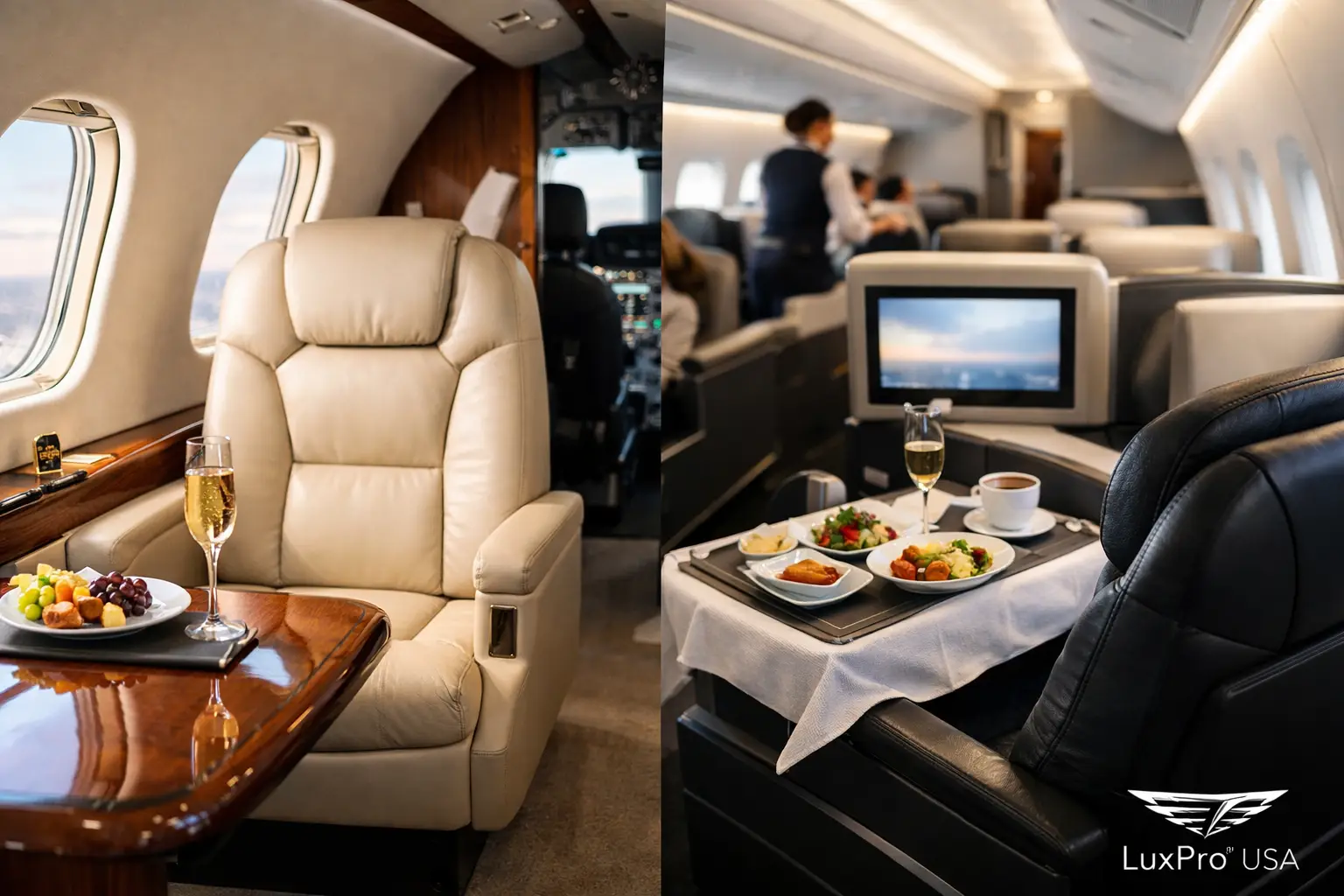
The real question in private jet vs first class is not which one looks better on paper. It is which one protects your time, privacy, and energy on the days when those things carry the highest value.
For some travelers, first class is more than enough. It offers comfort, strong airline networks, and a premium airport experience at a fraction of the cost of chartering an aircraft. For others, especially executives, public figures, families, and travelers moving on a tight schedule, private aviation solves problems commercial cabins simply cannot. The difference is less about luxury alone and more about control.
Private Jet vs First Class: What Actually Changes?
At a glance, both options promise a higher-end travel experience. You avoid the standard cabin, receive better seating, and gain a greater level of service than most passengers. That is where the similarity begins to thin out.
A first class ticket upgrades your seat within the commercial system. You are still tied to airline schedules, hub routing, terminal congestion, security lines, boarding processes, and the unpredictability of a shared environment. Private aviation changes the system itself. You choose the departure time, often the airport, the passenger list, and the pace of the day.
That distinction matters more than many travelers realize. If your meeting runs late, if your family needs a quieter departure, or if your security profile calls for discretion, the value of private travel becomes operational, not just indulgent.
Time Is Usually the Deciding Factor
High-performing travelers rarely measure value by ticket price alone. They measure it by lost hours, unnecessary friction, and how much of the day remains intact when they arrive.
First class can certainly reduce stress compared with business or economy. Priority check-in, lounge access, early boarding, and more comfortable cabins all help. But you are still entering a crowded system built for volume. Delays, gate changes, long taxi times, and missed connections do not disappear just because your seat is in the front of the aircraft.
Private jet travel compresses the airport experience dramatically. Travelers often arrive much closer to departure, move through private terminals, and avoid the usual traffic flow of a major commercial airport. For clients with packed schedules, that difference can reclaim several hours in a single day.
On shorter regional trips, this can be the deciding advantage. A route that feels cumbersome on a commercial airline may become efficient and same-day practical on a private aircraft. That matters for executives moving between meetings, entertainment professionals balancing production calendars, or families trying to avoid turning a simple trip into an all-day exercise.
Privacy Is Not the Same as Comfort
First class is comfortable. It is not private.
Even in excellent commercial cabins, you remain in a shared space with crew, other passengers, terminal staff, and the general movement that comes with public travel. Conversations can be overheard. Work can be interrupted. Security concerns may be managed, but they are not removed.
Private aviation offers a very different environment. You control who is on board. Sensitive discussions can happen without neighboring passengers. Families can travel without the pressure of managing children in a public cabin. Public-facing individuals can avoid attention that comes with crowded terminals and boarding gates.
For many affluent travelers, privacy is not a vanity benefit. It is a practical requirement. That applies equally to corporate strategy conversations, family travel, estate-level movement, and clients who simply value discretion as part of a well-run life.
The Route Network Tells a Bigger Story
One of the clearest advantages of first class is access to major airline networks. If you are flying between major cities on a well-served route, first class can be a very sensible choice. You may enjoy a lie-flat seat, polished onboard service, and an efficient nonstop itinerary for far less than the price of a charter.
Private aviation, however, opens a broader map. Smaller regional airports, closer-to-destination arrivals, and more direct routing can change the quality of a trip entirely. Instead of landing at a large airport and adding a long ground transfer, you may be able to arrive much nearer to your final destination.
In places where traffic is a serious variable, that matters. A traveler headed to Malibu, Calabasas, or a more private coastal or estate location may place a high value on reducing airport exposure and post-flight driving time. The aircraft is only part of the equation. The full travel chain is what determines whether the day feels efficient or exhausting.
Cost Is the Obvious Trade-Off, but Not the Only One
This is where the comparison becomes more nuanced. First class is almost always the more economical option for one or two travelers, especially on scheduled long-haul routes. In pure ticket terms, commercial premium cabins deliver meaningful comfort without the financial commitment of a private aircraft.
Private jet charter is a premium decision. There is no reason to soften that. But cost can look different depending on the trip. If several passengers are traveling together, if a same-day round trip avoids an overnight stay, or if the business value of time is substantial, the math can shift.
There is also the hidden cost of commercial inefficiency. Missed meetings, extra hotel nights, schedule compromises, and fatigue all have a price, even if they do not appear on the fare breakdown. For clients whose time carries significant financial or strategic value, private aviation can be a rational choice rather than an extravagant one.
That said, not every trip justifies a charter. A well-planned first class itinerary may be the smarter move when schedules are flexible, airport exposure is not a concern, and the route is well served.
Private Jet vs First Class for Business Travel
For corporate travelers, the best choice depends on what is happening before and after the flight.
If the trip is a straightforward city-to-city route with a predictable schedule, first class often works well. It presents a polished experience, supports productivity to a degree, and keeps travel budgets more controlled. For many companies, that is the right balance.
Private aviation becomes more attractive when the trip includes multiple stops, tight timing, confidential discussions, or senior leadership movement where delays have a wider impact. It also becomes compelling when executives need to arrive rested, protected, and ready to perform without the drain of the commercial process.
This is where integrated travel support matters. Air travel decisions do not exist in isolation. The value increases when flights, VIP ground transportation, timing, and security considerations are coordinated under one plan rather than patched together through separate vendors.
For Families and Leisure Travelers, the Answer Depends on Stress Tolerance
Some families love first class. If the route is nonstop, the children are seasoned travelers, and airport logistics are manageable, it can be an elegant and cost-conscious way to travel well.
Other families are not paying for extra luxury when they book private. They are paying to remove friction. Fewer public touchpoints, easier boarding, flexible departure timing, and a more controlled environment can make the trip substantially easier. That is especially true with young children, older family members, pets, or travelers with specific privacy needs.
The same is true for leisure travel built around a larger experience. If the goal is to arrive calm, on time, and without the drag of a public terminal, private aviation supports the lifestyle expectation many high-net-worth travelers now consider standard rather than exceptional.
When First Class Is the Smarter Choice
There are plenty of cases where first class wins. Long international routes with top-tier airline cabins can be highly comfortable. Major cities often have excellent premium service options. If your schedule is fixed and the airline timetable works in your favor, commercial first class can deliver real value.
It is also the right choice for travelers who want an elevated experience but do not need customized departure times, private terminal access, or a closed passenger environment. Luxury does not always require exclusivity at the aircraft level.
When Private Aviation Earns Its Price
Private aviation tends to justify itself when the stakes are higher. Urgent travel, compressed schedules, difficult routing, high-profile passengers, family complexity, or a strong need for confidentiality all push the decision in that direction.
It also earns its place when travel is being managed as a full-service experience rather than a flight purchase. That means the aircraft, the vehicle on arrival, the timing, and the client handling all work together. For travelers who expect that standard, a concierge-led model often feels less like an upgrade and more like the correct operating level.
LuxPro® USA serves clients who think this way – not simply booking transportation, but protecting time, privacy, and standards across the entire itinerary.
So, Which Wins?
Private jet vs first class is not really a battle between two luxury products. It is a choice between premium comfort inside a public system and complete control over the travel experience.
If your priority is value with comfort, first class may be exactly right. If your priority is discretion, flexibility, and reclaiming time at every stage of the journey, private aviation usually pulls ahead.
The smartest travelers do not treat this as a status decision. They match the mode to the mission. And that is usually where the best travel choices begin.