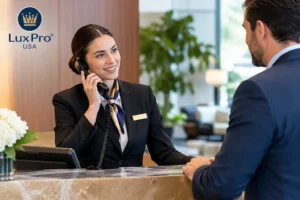


A board dinner starts late because the airport transfer missed the terminal change. A keynote speaker arrives, but their credentials are not at the desk. The venue is polished, the guest list is strong, and the budget is significant – yet one weak point in coordination can still shift the entire tone of the event. That is where a meetings and events concierge proves its value.
For companies, private hosts, and high-expectation clients, event success is rarely about decor alone. It is about timing, discretion, movement, guest experience, and the ability to solve problems before they become visible. A meetings and events concierge brings those details under one standard of care, so the event feels composed from the first arrival to the final departure.
What a meetings and events concierge really manages
The term can sound simple, but the scope is broader than many people expect. A true concierge function is not limited to check-in support or restaurant reservations for visiting guests. In a premium setting, it becomes the control point for the full guest and executive experience.
That may include airport arrivals, chauffeured movement between venues, VIP meet-and-greet support, scheduling coordination, special requests, security-aware routing, hospitality arrangements, and ongoing communication between principals, assistants, drivers, venue teams, and event staff. The work is both visible and invisible. Guests notice how smooth the day feels, while the most critical labor happens behind the scenes.
This matters even more when the event includes senior leadership, investors, talent, high-net-worth families, or guests who are accustomed to a certain level of service. In those environments, small delays feel larger. So do privacy lapses, inconsistent communication, and fragmented vendor handoffs.
Why standard event coordination is often not enough
Many event planners are excellent at design, programming, and venue management. That is not the issue. The gap usually appears when guest logistics become more complex than the event agenda itself.
A planner may secure the ballroom, finalize the menu, and manage registration flawlessly. But if the event includes private aviation arrivals, secure executive transportation, last-minute itinerary changes, personal assistance for VIPs, and family office-level discretion, a standard planning model can get stretched quickly.
A meetings and events concierge works differently because the assignment is not just the event. It is the movement around the event, the personal preferences inside the event, and the controlled execution that protects the host’s reputation.
That distinction is especially valuable for multi-day conferences, incentive programs, private celebrations, investor gatherings, entertainment events, and executive off-sites. The more layered the experience, the more important it becomes to have one trusted team coordinating the parts that most vendors only touch briefly.
The guest experience starts before arrival
The strongest concierge support begins well before the first car is dispatched. Travel details are confirmed early. Arrival windows are monitored. Preferences are documented. Security needs, communication protocols, and special accommodations are reviewed before anyone steps on site.
This preparation reduces friction in ways guests feel immediately. The right vehicle arrives. The chauffeur knows the schedule. A delayed flight does not create confusion. A principal who needs privacy is not routed through a crowded pickup pattern if a better option exists. A spouse, assistant, or security detail is not left to improvise.
That level of planning also protects the host. Instead of fielding calls about luggage, transfers, dietary requests, or hotel timing, the host can stay focused on the event itself. For executives and private clients, that alone can justify the investment.
Meetings and events concierge services are about control, not excess
Luxury is often misunderstood in business settings. It is not always about visible extravagance. Often, it is about control.
Control means the speaker arrives calm and on time. It means the family office does not have to brief three separate transportation providers. It means security, hospitality, and scheduling are aligned instead of operating in separate lanes. It means guests with high expectations are handled with consistency, not improvisation.
That is why premium concierge support tends to matter most when the stakes are high. A shareholder meeting, executive summit, private launch dinner, or destination celebration does not need more moving parts. It needs fewer gaps between them.
For some events, that may mean a light-touch support model with transportation oversight and VIP guest care. For others, it may involve comprehensive management across travel, arrivals, venue timing, executive protection coordination, and after-hours requests. The right scope depends on the guest profile, the venue environment, and how much complexity sits behind the scenes.
Where concierge support adds the most value
Not every event requires concierge-level coordination. A simple internal lunch meeting probably does not. But once an event includes status-sensitive guests, layered logistics, or privacy concerns, the equation changes.
Corporate events benefit when senior executives, board members, or top clients need coordinated movement and polished hospitality. Private events benefit when hosts want family, friends, or invited guests cared for without managing requests personally. Entertainment and media events benefit when timing shifts quickly and confidentiality matters. Estate-based gatherings benefit when transportation, staffing, property access, and guest handling must all be managed with discretion.
There is also a practical advantage in using one provider that can coordinate across transportation, personal assistance, and security-aware service standards. Fewer handoffs usually mean fewer missed details.
That does not mean one-size-fits-all service. The best concierge programs are tailored. A Malibu coastal event has different operational needs than a downtown Los Angeles corporate dinner or a multi-city executive roadshow. Terrain, traffic patterns, security posture, guest expectations, and venue access all shape the service plan.
The difference is in the details people remember
Guests may not remember which team managed the logistics. They will remember how the event felt.
They remember whether arrival was smooth or chaotic. Whether someone capable handled a last-minute request without making it awkward. Whether transportation felt polished. Whether the evening stayed on schedule without feeling rushed. Whether privacy was respected naturally, not as an afterthought.
That memory becomes part of the host’s reputation. For companies, it reflects brand standards. For private clients, it reflects personal standards. In both cases, concierge support is not only operational. It is reputational.
This is one reason affluent clients and executive teams often prefer a white-glove provider rather than piecing together transportation, event staffing, and guest services from separate sources. A consolidated model creates accountability. If timing shifts, there is a central team adjusting the experience in real time.
Choosing the right meetings and events concierge
Experience matters, but the right kind of experience matters more. A provider may understand event staffing while lacking the discretion required for high-profile guests. Another may offer luxury transportation but not the communication discipline needed for a complex event environment.
The better question is whether the team can operate confidently across hospitality, logistics, and privacy-sensitive service. Are the staff screened and professional? Can they support executive-level movement without confusion? Do they communicate clearly with assistants, venues, and principals? Can they adapt when plans change two hours before guest arrival?
That last point is not minor. Events rarely unfold exactly as scheduled. Flights shift. Principals add stops. Weather changes traffic patterns. Guest counts move. A strong concierge team does not treat those changes as disruptions. It treats them as part of the assignment.
For clients who want a single trusted partner, LuxPro® USA reflects this model well. The advantage is not simply access to premium transportation or event support on paper. It is the ability to coordinate white-glove service, guest movement, and discretion-driven logistics under one experienced umbrella.
Why this role keeps growing
Events have become more compressed, more personalized, and more demanding at the same time. Guests expect efficiency, but they also expect thoughtful treatment. Hosts want impact, but they do not want visible strain. Executives want protection of their time. Private clients want comfort without exposure.
A meetings and events concierge meets that moment because the role sits at the intersection of service and control. It supports the event itself, but more importantly, it protects the experience around it.
When that experience is handled correctly, the event feels easy. That is the real standard. Not flashy execution, but disciplined execution with polish. If your event includes people who notice every detail, the right concierge support is not an extra touch. It is often the difference between an event that simply happens and one that feels unmistakably first class.
The smartest hosts know this early: guests do not measure quality by effort they can see. They measure it by how little friction they feel.